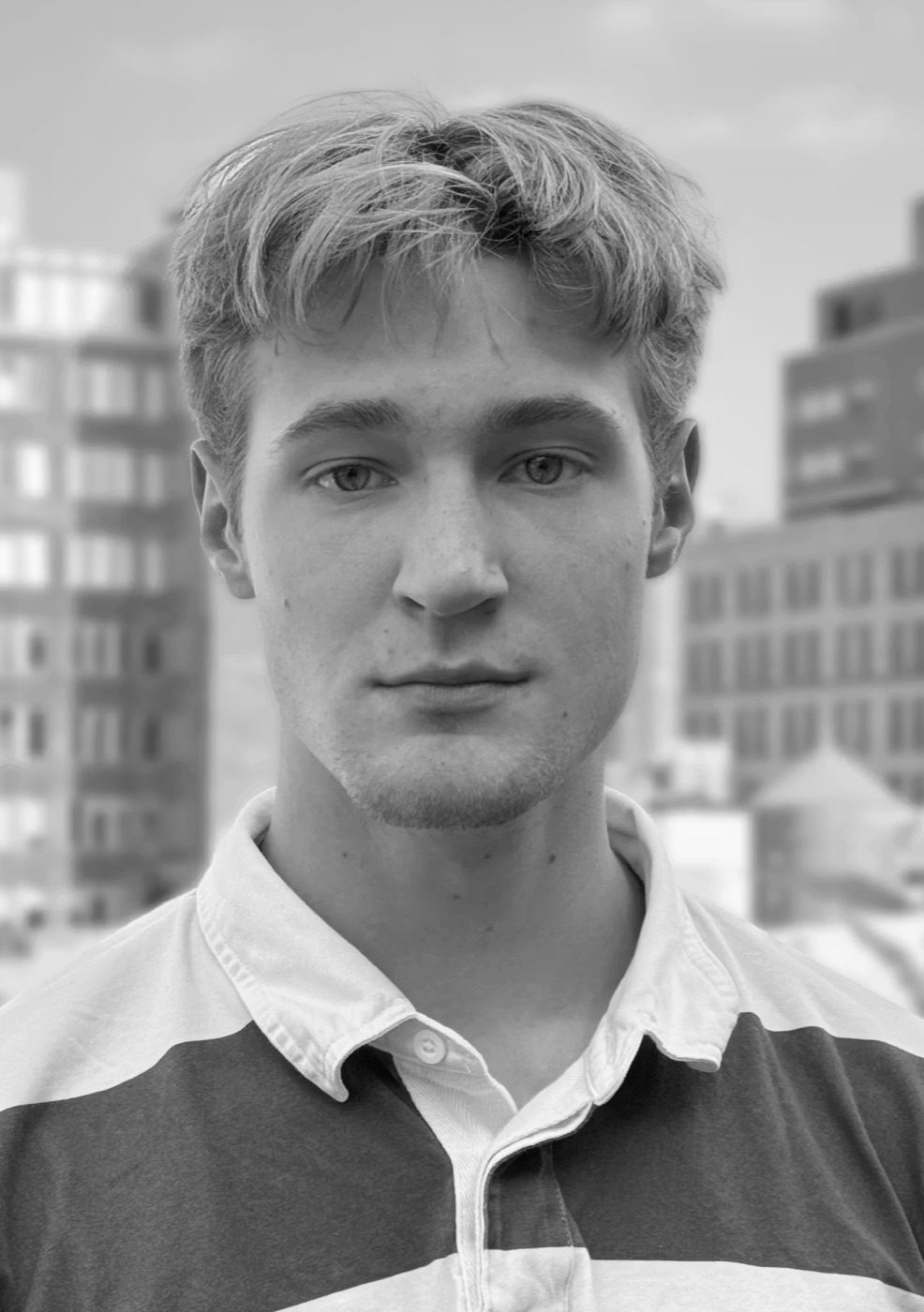
About
I started coding when I was eight, beginning with games, and put my first mobile game on the App Store at nine. When coding agents arrived, I worried for a while that the thing I loved was about to become obsolete. Then I started using them and found that what I loved was building, and agents made building faster and more fun. Now I spend most of my time building the agents themselves.
Teaching started early too. In high school I spent the summers of 2021 and 2022 as a teaching assistant for Cornell Blockchain's eight-week bootcamp, and from 2023 to 2024 I tutored Python on Wyzant for more than 150 hours. Teaching something is still how I check that I understand it well enough to use it.
I spent my first year of college in Lehigh University's Computer Science and Business honors program, then transferred to Cornell, where I study Information Science with minors in Computer Science and AI. I graduate in May 2027.
Work
I've spent two summers at InstaLILY, a startup (now Series B) that builds agentic software for the sales teams of distribution companies. In my first summer I was the only developer moving a legacy sales assistant onto the Model Context Protocol, and I shipped features on the company's AI sales-analytics product. In my second summer I worked on Lily, the company's coding agent, with the small team that built it, as an AI + RL Harness Engineer intern. I wrote harness extensions for subagent and multi-agent delegation.
I led the design of Lily-Eval, which I built with a few colleagues; my main piece was the package that turns a repository's merged pull requests into graded tasks. The result is an RL environment for Lily's harness, a reward signal that tells us whether a harness change helped on our own code. InstaLILY published the method and results in a two-part research report in July 2026. I led the evaluation work in Part 1 and helped synthesize the final draft.
I joined Cornell Generative AI in spring 2025. My first project was a vendor due-diligence agent for QuickFi, where I built the Dun & Bradstreet integration, the conflict-of-interest detection and the risk scoring. I went on to design the club's new member curriculum, and I'm now president of the 40+ member club, and I run it like a startup. I also built the club's internal operations platform on my own, with coding agents doing much of the implementation.
Stuart Labs is the name I put on what I build on my own. At its center is ego-OS, a personal context engine that gives every agent I run a model of me over MCP. Outreach CRM is a multi-tenant networking CRM I founded and built alone. I pitched it to Cornell Generative AI in August 2026 as the first product in the club's student-products track. The club is its first organization, and it is in a private pilot. HomeAssist is a voice assistant whose first version ran on a Raspberry Pi. echo-OS speaks a short headline when a long Claude Code turn finishes, so I can run several agents at once and hear which one is done. AgenticNodes is a graph editor and runtime for agent workflows.
At Cornell I'm also on a two-person CS 4701 team building HIVE, a scaffold for self-improving agent harnesses. I wrote the spec and have built the codebase so far, with Claude Code subagents implementing modules against it.
How I work
I write the spec before the code. I put clear contracts at the boundaries most likely to change, so a model or a provider can be swapped without rewriting the code around it. I measure before I tune, because an agent change with no evaluation behind it is a guess. And I keep a written log of decisions as I go, since the next person to read the code (often me) needs to know why it looks the way it does.
Why startups
One day I intend to build a startup. Running the club and building Outreach CRM showed me that I like the work around the code as much as the code. We recruit through a take-home build and an interview, and this fall I rebuilt the interview's technical half around agent design. I opened sponsorship conversations with Databricks and Moonshot AI for compute and API credits. When client work left members with little public proof of what they built, I argued in an e-board check-in that we should lead our own building, and we gave up client work for our own products, open source and research. In Outreach CRM I dropped a provider batch pipeline I had designed and a vector store I had already built, because nothing in version one needed them.
Before I start my own company, I want to learn from people who have done it, at a company small enough that I own real problems and hear from users quickly.
If you're building something early and want to talk, email me at morgan@morgannstuart.com.
Experience
Summers 2025 and 2026
InstaLILY · Software Engineer Summer Associate (2025), then AI + RL Harness Engineer intern (2026)
Wrote harness extensions for subagent and multi-agent delegation in Lily, the company's coding agent, alongside the small senior team that built it on LangChain DeepAgents. Led the design of Lily-Eval, the evaluation environment behind Part 1 of InstaLILY's public research report, which I built with a few colleagues; my main piece was the package that turns a repository's merged pull requests into graded tasks. In my first summer I was the sole developer moving a legacy sales assistant onto MCP.
Spring 2025 – present
Cornell Generative AI · President (earlier lead engineer and New Member Education chair)
Joined as an engineer in spring 2025 and designed the new member curriculum before becoming president. I now run the 40+ member club, including recruiting, client and sponsor work, and its fall 2026 move to self-led products.
May 2023 – Aug 2024
Wyzant · Python tutor
Tutored Python one on one online for more than 150 hours, with 100% 5-star reviews.
Summers 2021 and 2022
Cornell Blockchain Bootcamp · Teaching assistant
Helped teach an eight-week blockchain curriculum while I was still in high school.
Education
Expected May 2027
Cornell University · B.S. Information Science, Data Science concentration; minors in Computer Science and AI
Transferred after my first year at Lehigh. This fall I'm taking a course on AI agents and retrieval (INFO 5940), Intro to Robotics, and Computer System Organization.
2023–2024
Lehigh University · Computer Science and Business (CSB Honors)
Completed my first year in the honors Computer Science and Business program and made the Dean's List twice before transferring to Cornell.